
Why Does Nuote Metals Insist on Manufacturing Brass Eyelets – And When Should You Use Them?
Article Summary: At Nuote Metals, we have manufactured brass eyelets for over a decade. In this guide, we walk you through what brass eyelets are, the different types available, and the exact technical specifications we use—including material grades, sizes, tolerances, and finishes. We also share real application cases from our customers in marine, electrical, and leather goods sectors, along with our ISO quality control and RoHS compliance policies. Finally, we answer the three questions we hear most often. By the end, you will know exactly what brass eyelets can do for your product and why working with a real factory matters.
Steel eyelets rust. Aluminium ones are too soft. Plastic grommets crack under load. For applications that demand both function and longevity, brass eyelets deliver. At Nuote Metals, we have produced brass eyelets for marine covers, electrical terminals, leather goods, and industrial textiles for over ten years. We know what works—and what does not.
This guide shares our factory-floor knowledge: what brass eyelets actually are, the technical parameters we manufacture to, and the real-world cases where our customers have relied on them. No marketing fluff. Just engineering facts.
What Exactly Are Brass Eyelets? (Our Factory Definition)
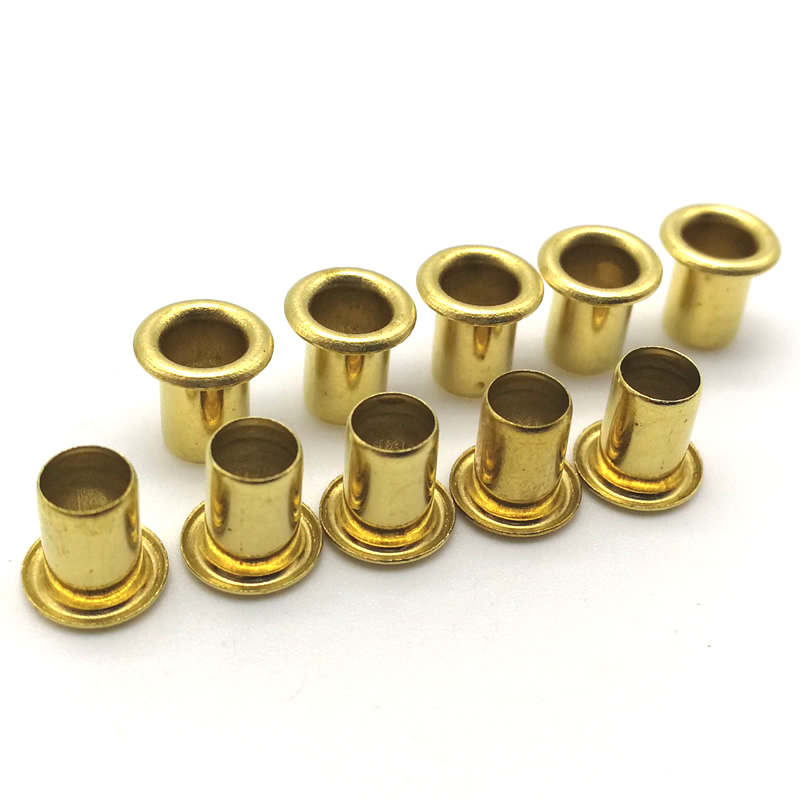
A brass eyelet is a hollow metal ring, usually made from a copper‑zinc alloy, designed to reinforce a punched or drilled hole in a material such as fabric, leather, plastic sheeting, or thin metal. Unlike solid rivets that clamp two layers together, the primary job of an brass eyelet is to protect the hole edge from tearing or fraying and to provide a smooth, durable passage for laces, cords, wires, or fasteners.
At Nuote Metals, we manufacture brass eyelets in a single‑piece construction—a flanged head at one end and a hollow barrel at the other. During installation, the barrel is rolled or curled outward against a setting tool, creating a permanent, flush‑fitting reinforcement. For heavier‑duty applications, we also supply mating washers (plain or spur‑toothed) that add pull‑out resistance.
Brass Eyelets vs. Grommets – A Quick Clarification
Customers often ask us the difference. Here is how we explain it:
| Feature | Brass Eyelets | Brass Grommets |
|---|---|---|
| Construction | One piece (integral flange and barrel) | Two pieces (ring + separate washer) |
| Typical hole size | Up to about 12 mm | Larger, often 12 mm and up |
| Primary use | Light‑medium reinforcement (textiles, leather, PCBs) | Heavy‑duty reinforcement (tarps, industrial curtains, canvas) |
| Setting method | Barrel rolled or curled | Two‑piece clamped or pressed |
For smaller holes (under 12 mm) and moderate loads, brass eyelets are the right choice. For larger holes or heavy‑duty pull‑out resistance, we recommend brass grommets.
Our Brass Eyelet Types – A Complete Reference Table
At Nuote Metals, we produce brass eyelets in three main configurations. The table below shows how they differ and which applications suit each type.
| Type | Description | Best For |
|---|---|---|
| Standard (Flat Flange) Brass Eyelets | Plain rolled or flat flange, one‑piece construction | General hole reinforcement: fabric, canvas, banners, upholstery |
| Spur Brass Eyelets | Sharp teeth (spurs) on the underside of the flange that bite into the material | Leather, thick fabric, marine covers where pull‑out resistance is critical |
| Shoulder / Stepped Brass Eyelets | Barrel with a shoulder or stepped profile | Multi‑layer materials or applications requiring a spacer between layers |
Our recommendation: For most textile and light‑duty jobs, standard brass eyelets work perfectly. For leather or high‑movement applications (boat covers, tarpaulins, belts), we suggest spur brass eyelets—the teeth lock into the material and prevent spinning and pull‑out.
Technical Specifications – What We Deliver (Real Data)
We do not guess. Every batch of brass eyelets leaving our factory meets the following parameters. These are the numbers our customers in aerospace, marine, and electronics rely on.
Standard Sizing and Tolerances
| Parameter | Range / Value | Tolerance |
|---|---|---|
| Shank (Barrel) Outside Diameter | 0.8 mm – 10 mm | ±0.05 mm |
| Flange Outside Diameter | 3 mm – 25 mm (customizable) | ±0.10 mm |
| Barrel Length (Under Flange) | 1.5 mm – 12 mm (material‑stack dependent) | ±0.10 mm |
| Material Thickness (Brass Sheet) | 0.3 mm – 1.5 mm | ±0.03 mm |
| Concentricity (Barrel to Flange) | ≤ 0.1 mm TIR | 100% visual inspection |
Shank diameter tolerance of ±0.05 mm is our standard. For precision electronics or medical device applications, we can tighten this to ±0.02 mm upon request.
Brass Alloys We Stock
| Alloy | Copper % | Zinc % | Key Properties | Typical Use |
|---|---|---|---|---|
| C26000 (Cartridge Brass, 70/30) | 70 | 30 | Highest ductility, excellent for rolling and forming | Standard eyelets for general textile and leather |
| C27000 (Yellow Brass, 65/35) | 65 | 35 | Good strength and formability, cost‑effective | Industrial eyelets, medium‑load applications |
| C23000 (Red Brass, 85/15) | 85 | 15 | Superior corrosion resistance, richer red‑gold colour | Marine covers, saltwater exposure, heritage restorations |
For 90% of our customers, C26000 brass eyelets are the ideal balance of formability, strength, and corrosion resistance. For marine applications, we recommend C23000 red brass eyelets—the higher copper content provides exceptional saltwater resistance.
Available Surface Finishes
| Finish | Process | Properties |
|---|---|---|
| Natural Brass | As‑formed, vibratory tumbled | Warm gold colour, may tarnish over time |
| Lacquered | Clear protective coating | Prevents tarnishing, maintains bright finish |
| Nickel‑Plated | Electroplated nickel | Bright silver appearance, increased wear resistance, enhanced corrosion protection |
| Antique / Oxidised | Chemical patina treatment | Darkened, aged bronze look for vintage products |
| Tin‑Plated | Electroplated tin | Solderable surface for electrical applications |
All finishes are RoHS compliant.
Where Our Customers Actually Use Brass Eyelets (Real Cases)
We do not just publish product lists—we solve real problems. Here are actual applications where our customers rely on Nuote Metals brass eyelets.
Marine Covers and Boat Tops
A customer in Florida builds custom boat covers. Saltwater exposure and constant wind stress had been destroying their cheaper steel eyelets within months. We supplied C23000 red brass spur eyelets with plain brass washers. The result: three seasons of saltwater use with no corrosion, no pull‑out, and no customer complaints. The spurs lock into the canvas, preventing rotation and reinforcing the hole edges.
PCB Electrical Terminals
An electronics manufacturer needed a reliable through‑hole connection for a double‑sided circuit board. They tried plated‑through holes but experienced pad lifting during soldering. We supplied tin‑plated brass PCB eyelets in 2 mm diameter. The eyelets provide both mechanical reinforcement (preventing copper foil peeling) and a conductive pathway. The tin plating ensures excellent solderability and low contact resistance.
Leather Bags and Belts (High‑End Fashion)
A leather goods brand in Italy wanted a fastener that would not tarnish quickly and would match their premium brass hardware. We supplied lacquered C26000 brass eyelets in 5 mm and 7 mm sizes, polished to a bright gold finish. The lacquer prevents finger marks and keeps the eyelets looking new. The brand now specifies our brass eyelets for every belt and bag in their collection.
Electrical Earthing and Grounding Panels
An industrial panel builder needed a non‑magnetic, corrosion‑resistant fastening point for earthing lugs. Brass has about 28% IACS electrical conductivity, making it suitable for grounding applications. We supplied plain C26000 brass eyelets with extra‑wide flanges. The eyelets create a permanent, conductive connection point that does not loosen under vibration and will not rust over time.
Our Quality Assurance and Certifications – Real Transparency
We do not just claim quality. We prove it.
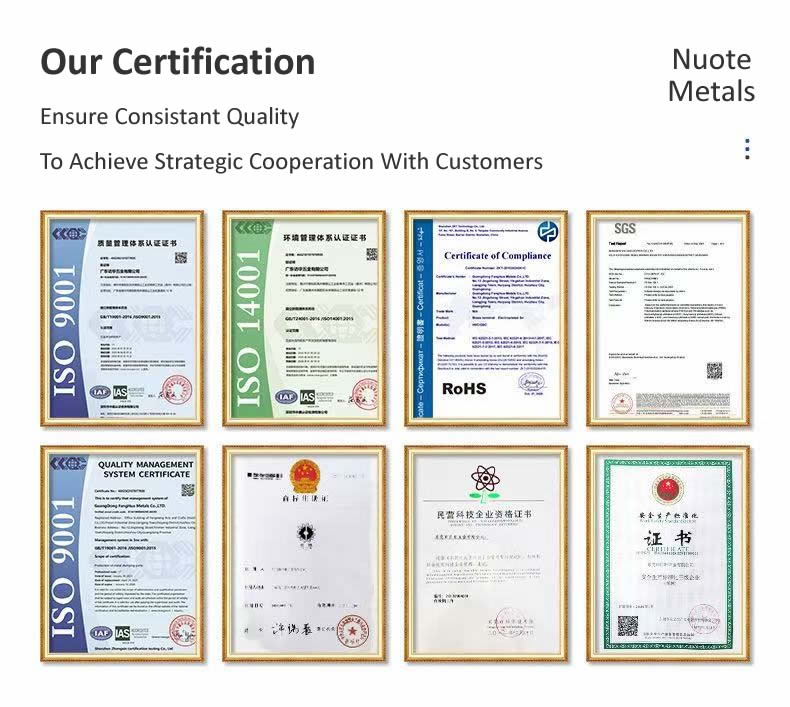
ISO 9001:2015 Certified Production
Our factory operates under ISO 9001:2015 quality management systems. Every batch of brass eyelets undergoes:
100% whole‑range inspection during production (not just spot checks)
Dimensional inspection – shank OD, flange OD, barrel length, concentricity
Hardness verification – ensures consistent roll formation without cracking
Plating thickness testing – for nickel, tin, and other finishes
Our quality control team documents every inspection. If we say the shank diameter is 3.00 mm ±0.05 mm, that is what you get—batch after batch.
RoHS Compliance
All brass eyelets from Nuote Metals are RoHS compliant. We maintain supply chain documentation and can provide compliance certificates upon request. No restricted substances. No guesswork.
Our Transparent Customer Policies
We have built our reputation on straightforward, honest business practices:
Free samples – For sizes we have in stock. You pay only the express shipping charge. Test before you commit.
Custom tooling within 10 days – Need a non‑standard flange shape, barrel length, or diameter? We design and cut tooling in‑house.
100% inspection before shipment – Every product is checked by our QC department. No shipment leaves without sign‑off.
MOQ 20,000 pieces – Flexible for standard sizes; lower volumes available for sample runs.
Lead times – Stock sizes: 3–5 days. Non‑standard: 15–25 days, including custom tooling.
8‑hour inquiry response – Our sales team replies to technical questions within one business day.
We have supplied brass eyelets to customers in over 70 countries. Our customers stay with us because we deliver what we promise.
【brass eyelets】FAQ – Answers to the Three Questions We Hear Most
Q1: What is the difference between a plain brass eyelet and a spur brass eyelet? Which one should I choose?
A: At Nuote Metals, we manufacture both. The difference is the underside of the flange. A plain brass eyelet has a smooth, flat flange. It sits flush against the material and is suitable for stationary or low‑movement applications—such as banners, signage, upholstery, and clothing. A spur brass eyelet has small sharp teeth (spurs) stamped into the underside of the flange. When the eyelet is set, these spurs bite into the material, preventing the eyelet from rotating or pulling out under tension or vibration. Our recommendation: For marine covers, tarpaulins, canvas awnings, belts, and any application subject to movement or wind stress, choose spur brass eyelets. For indoor signage, light upholstery, or decorative uses, plain brass eyelets are sufficient and more economical. We can provide samples of both types so you can test the pull‑out resistance on your actual material.
Q2: Can brass eyelets be used outdoors or in saltwater environments? What alloy and finish should I specify?
Yes, but the alloy and finish matter. Standard C26000 (70/30) brass eyelets perform well in fresh water and mild outdoor conditions but can undergo dezincification in prolonged saltwater exposure. For marine or coastal applications, Nuote Metals recommends C23000 red brass eyelets (85/15 copper‑zinc). The higher copper content provides exceptional resistance to dezincification and saltwater corrosion. For the best possible corrosion protection in extreme marine conditions, we also offer nickel‑plated brass eyelets over a red brass base—the nickel layer adds an additional barrier. Our specific advice: For boat covers, dock hardware, and any product within 5 km of saltwater, specify C23000 red brass spur eyelets with plain or spur washers. For less demanding outdoor use (garden furniture covers, camping tarps), standard C26000 brass eyelets with a lacquered finish are usually sufficient. Free samples of both alloys are available for salt‑spray testing.
Q3: How do I calculate the correct brass eyelet barrel length for my material stack?
A: This is the most common technical question we receive. The correct barrel length depends on your total material thickness. For standard brass eyelets, the barrel must extend completely through the material stack and have enough protruding length to roll or curl over. Our formula: Barrel Length = Material Stack Thickness + 0.8 to 1.5 mm (the extra length forms the rolled curl). For example, if you are reinforcing a leather belt with a total thickness of 3.0 mm, you need a brass eyelet with a barrel length of approximately 3.8 mm to 4.5 mm. If the barrel is too short, the curl will be weak and the eyelet may pull out. If the barrel is too long, the curl will be too large or may split. For spur brass eyelets (with mating washers) , the calculation is slightly different because the washer adds thickness. The formula becomes: Barrel Length = Material Stack Thickness + Washer Thickness + 0.5 to 1.0 mm. Our recommendation: When in doubt, order free sample eyelets in two or three adjacent barrel lengths and test them on your actual material using your setting tool. Nuote Metals can supply sample kits exactly for this purpose—just tell us your material stack and we will suggest the correct lengths.
Why Our Customers Trust Nuote Metals for Brass Eyelets
We are not a trading company. We are a manufacturer with over ten years of dedicated experience in brass eyelets and precision metal stamping. Our factory in Dongguan, China, operates under ISO 9001:2015 certification.
One‑stop supply – Brass eyelets in all types (standard, spur, shoulder) and all alloys (C26000, C27000, C23000)
Custom tooling in‑house – New tooling ready within 10 days for custom flange shapes, barrel lengths, or diameters
RoHS‑compliant finishes – Natural brass, lacquered, nickel‑plated, antique, tin‑plated
100% quality inspection – Every batch checked for dimensions, hardness, and finish integrity
Free samples – Test before you commit
70+ countries supplied – Proven track record with marine, electronics, leather, and industrial customers
We also manufacture stainless steel eyelets, aluminium eyelets, and copper eyelets. So when a job calls for a different material, we can supply it without you needing a new vendor.
Contact Nuote Metals for Your Brass Eyelets Requirements
From boat covers that face Atlantic storms to PCB terminals that must conduct reliably for decades, brass eyelets from Nuote Metals deliver. Tell us your material, your environment, and your production volume. We will reply with a specific alloy and type recommendation, technical datasheets, and free samples.
Contact Nuote Metals today:
🌐 Website: www.nuotemetal.com
📧 Email: info@notinmetal.com
📞 Phone: +86 13316629095
Let us reinforce your product the right way.
お問い合わせを送信



X
当社は Cookie を使用して、より良いブラウジング体験を提供し、サイトのトラフィックを分析し、コンテンツをパーソナライズします。このサイトを使用すると、Cookie の使用に同意したことになります。
プライバシーポリシー